Main Literacy Programme

Main Literacy Programme - [MOE-Aided] (MLP [MA])

To Map, Lead and Provide a comprehensive and high-quality programme  for those who learn differently, including those with dyslexia, delivered by inspired Educational Therapists

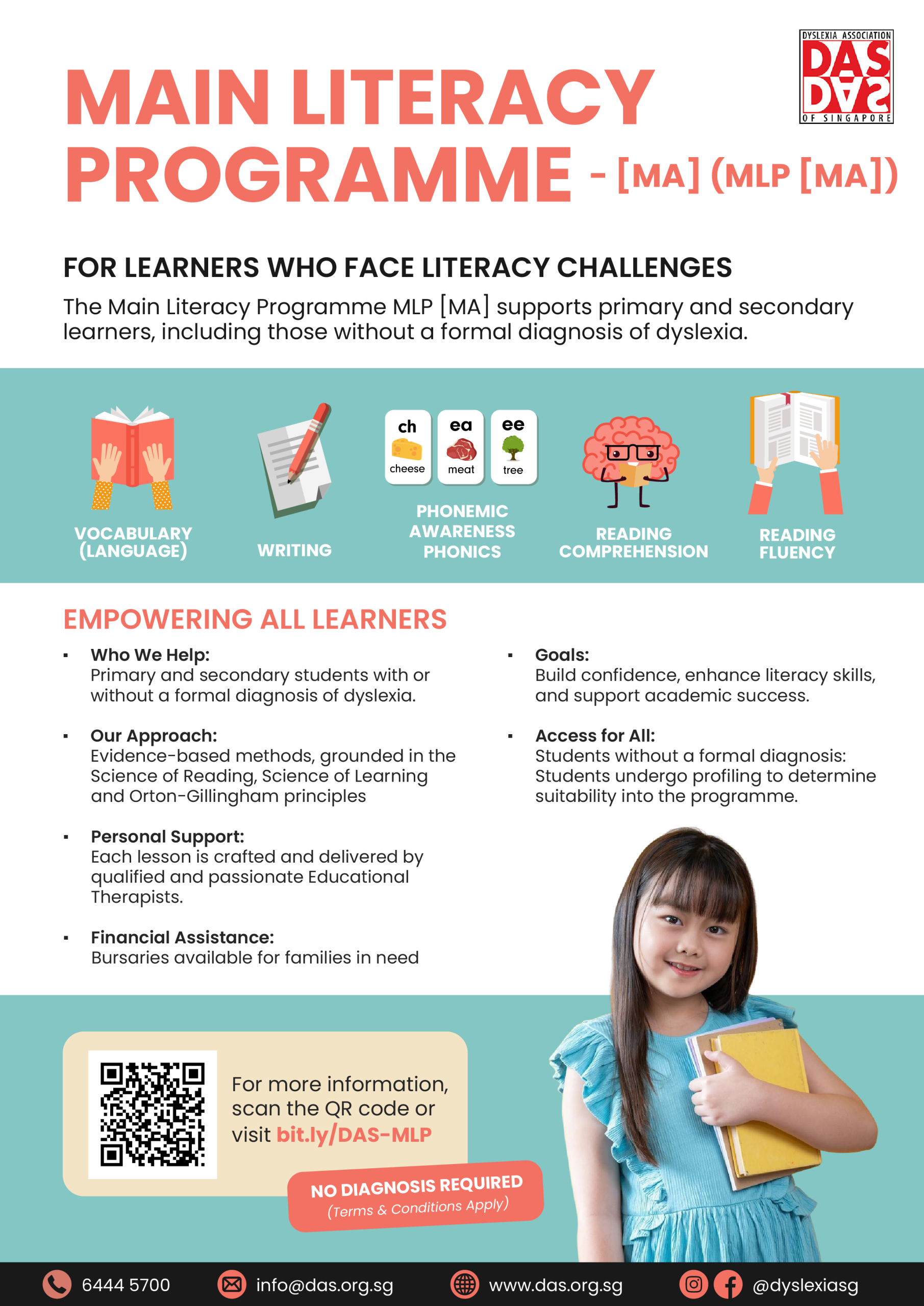
The MLP [MA], delivered by trained Educational Therapists, provides a comprehensive and quality curriculum that supports primary and secondary school learners with dyslexia and other specific learning differences as well as those students who face literacy challenges without a diagnosis. MLP [MA] aims to not only help students acquire the necessary literacy skills to cope with academic demands but also strives to provide a conducive learning environment for them to develop their strengths and build their confidence and resilience.

A diagnosis of a specific learning difference is no longer a prerequisite to access DAS Programmes. We have now opened our doors to struggling learners, whether they have a formal diagnosis of a learning difference or not. To access our programmes, all students will undergo profiling tests, a simple step to ensure they are placed in a class that best suits their learning needs.

Curriculum Framework

MLP [MA] provides a comprehensive and structured literacy curriculum for students who experience literacy challenges, including those with dyslexia or specific learning differences. Delivered by highly trained Educational Therapists, the programme provides:

  • Systematic, step-by-step progression towards programme completion
  • Structured lessons with clear objectives and learning outcomes with a segment of Responsive Instruction (RI) to address individual learning needs and gaps
  • Targeted literacy support to build students’ knowledge, skills and confidence

DAS Main Literacy Programme [MOE-Aided] (MLP [MA]) is part-subsidised by the Ministry of Education (MOE).

MLP [MA] Eligibility

MLP [MA] is subsidised by the Ministry of Education (MOE).

Students are eligible for MOE subsidy for the MLP [MA] under the following conditions:

  • The student has a diagnosis of dyslexia and
  • The student is a Singapore Citizen and is attending an MOE Mainstream School* which qualifies for MOE subsidy for the MLP [MA] , or
  • The student is a Singapore PR/Foreigner but has one Singaporean parent. The student is attending an MOE Mainstream School*, which qualifies for MOE subsidy for the MLP [MA] .

* A list of MOE Mainstream Schools can be found here:  MOE Mainstream Schools

  • The student must maintain at least 75% attendance.
  • For Secondary students enrolling from 1 January 2026 onwards
    • Students who achieved Achievement Levels (AL) 1 to 5 in PSLE English Language at the Standard level will not be eligible for MOE subsidy for MLP [MA] . These students may still enrol in the MLP [MA] under standard programme fees.

MOE subsidy will continue to be available for:

  • All primary school students
  • Secondary school students who achieved AL6 to AL8 in PSLE English Language (Standard level)
  • Secondary school students who took Foundation level PSLE English Language.
  • Secondary school students currently enrolled in the MLP [MA] before 1 January 2026

Please note that DAS and MOE will conduct a review of the student’s progress before his/her 48, 72 and 96 months on MLP [MA] to determine if he/she has reached specific achievement points to be eligible for continued MOE subsidy.

Students are eligible to attend only one MOE-funded dyslexia intervention programme. Parents/guardians are therefore required to inform DAS if their child is currently attending the School-based Dyslexia Remediation (SDR) programme or intends to enrol in the SDR programme. Each child may only attend either the SDR programme or MLP [MA]

For more information about the student’s eligibility, please contact DAS at [email protected]


Financial Assistance for other students on MLP [MA]

For students who do not meet the above criteria, standard fees will apply for the MLP [MA] . However, DAS is dedicated to supporting students in need and offers additional funding options for families requiring financial assistance.  

💙 Bursaries are available for ALL DAS Programmes.

Please reach out to us to discuss how we may be able to help.

For a Psycho-Educational Assessment, please click here.

The DAS Main Literacy Programme (MOE-Aided) [MLP(MA)] Evaluation is published in the DAS Handbook

Who we are

We are a dedicated team of professionals committed to providing the best possible support for individuals who learn differently, including those with dyslexia and other specific learning differences.

Our Educational Therapists go beyond simply delivering lessons; they apply a structured, evidence-informed approach to design, implement, and evaluate targeted interventions aligned with clearly defined learning frameworks. While the content is standardised to ensure consistency and quality, it remains responsive to each student’s learning needs, supporting their progress and development while nurturing a positive attitude towards learning. 

Together, we work to bring out the best in our students by creating a supportive, nurturing, and adaptive learning environment.

Our Team Includes:

  • Educational Therapists – Specialists in designing and delivering customised interventions.
  • Psychologists – Experts in assessments and understanding learning profiles to identify strengths and areas of improvement.
  • Educational Advisors – Guides who support our educational team with insights into appropriate educational solutions and strategies and provides mentorship to our team of specialists.
  • Curriculum Specialists – Innovators who develop curriculum resources and materials aligned with evidence-based practices for diverse learners.
  • EduTech Representatives – Advocates of educational technology that enhances learning experiences through engaging, interactive tools including the use of AI apps.

Find out more about our staff here

What do we assess for?

The Dyslexia Association of Singapore (DAS) provides support for:

  • Students from Primary 1 to Secondary 5 – Including those diagnosed with dyslexia, other specific learning differences, and students who are struggling with similar learning challenges.

  • Adults with Literacy Difficulties – We offer assistance for adults who may face challenges in literacy and wish to improve their skills.

Find out more about our SpLD Assessment Services (SAS) and how we can support you here

Educational Technology

Today, more than ever, the role of educational technologies is of great importance and it is becoming the commonplace in the area of education to harness the interest of students and add value to the learning objectives.

Technology integration for digital literacy and the 21st century skills of critical thinking and problem solving, collaboration and communication and information literacy have become increasingly important. By using technology, these skills can be imparted to the learners. However, to do this effectively, pedagogical models need to be used.

Some of the main guiding pedagogies employed by EdTech are TPACK and SAMR models. The TPACK – Technological, Pedagogical and Content Knowledge – is about designing lessons incorporating technology to support the arranged content through a pedagogically supported approach (Figure 1). The SAMR model (Figure 2) on the other hand facilitates the practical aspect and scales the various levels of use of educational technologies into four broad levels so that educators can know the level of their technology integration in the lesson (Substitution, Augmentation, Modification and Redefinition) and how they can further elevate the activity.

The EdTech Team is focused on the application and study of educational technologies and how it enhances skills and cognitive characteristics in both educators and learners. The team thus pilots and leads initiatives with educational technologies such as studying users’ perceptions on uses of iPads in the DAS classrooms, the impact of Mimio Teach Smart Bars on educators and dyslexic learners, and the formative approach to the digitalisation of the Curriculum-Based Assessments.

EdTech in DAS is at its beginning stages but the bigger plans are on the way to ensure that not only traditional learning methods are modernised but also that the use of educational technologies is purposeful to student-oriented learning.

Our Curriculum

The Main Literacy Programme – [MOE-Aided] (MLP [MA])  provides a comprehensive and quality curriculum to support students with dyslexia facing literacy challenges. (MLP [MA])  curriculum integrates key essential learning components that are crucial in remediating students with learning difficulties and these recommended areas of instruction are adapted from the National Reading Panel, 2000.

PROGRESS MONITORING

Our students’ progress is monitored closely through bi-annual curriculum-based assessments – MAPTrack – conducted by our Educational Therapists. This close evaluation allows our Educational Therapists to make informed and needful adjustments in their teaching to address the needs of the child. Our lessons are not static it allows for flexibility to suit the varied needs of our dyslexic students.

As awareness grows and more students with learning differences receive exam access arrangements nationally, our tailored approach ensures that students are well-prepared not just academically, but also supported in a way that aligns with these broader inclusive efforts. DAS remains committed to equipping each learner to thrive with the right support.

Click here to read an article by Dr Geetha Shantha Ram, Director of the English Language and Literacy division, and Kathleen Chan, Senior Specialist Psychologist, featured in The Straits Times, which highlights the growing importance of inclusive exam arrangements for students with learning needs.

What We Teach

Phonemic Awareness and Phonics

The provision of a multi-sensory and highly structured phonetic instruction through the Essential Literacy Approach (ELA) has been incorporated into (MLP [MA]) lessons to promote and facilitate reading and spelling development in our students.

Reading Fluency

(MLP [MA]) lessons emphasise the importance of reading fluency through the deliberate planning of reading tasks that take into account students' reading fluency and accuracy to ensure that reading comprehension is not impaired by effortful and inaccurate reading.

Reading Comprehension

The Reading Comprehension Curriculum includes essential reading comprehension skills that are closely aligned with the mainstream curriculum. It also consists of skills that are taught and delivered according to the PPP (Presentation, Practice, Production) stages to:

  • facilitate the pre-activity discussions through modelling
  • scaffold and guide students in a structured, cumulative and sequential manner to enhance learning
  • provide opportunities for students to be independent in applying the concepts/skills learnt

Writing

Writing is taught to students in a structured, cumulative and sequential manner. The process of writing emphasises not only on skills such as planning, drafting, revising and editing, it also stresses upon the importance of linguistic knowledge, such as grammar and text structure, to make writing more focused and meaningful for our students.

Vocabulary

Beyond phonics, (MLP [MA]) explicitly emphasises vocabulary development of morphemes, sight and high frequency words through instructions leveraging on Assistive Technology to improve students' language acquisition skills.

Localisation of Curriculum

The (MLP [MA]) curriculum and resources have been localised to better suit our bilingual learners and more importantly, to make learning more accessible and contextualised for them.

Watch examples of what our (MLP [MA]) classes are like:

How are we different?

The Main Literacy Programme – [MOE-Aided] (MLP[MA]) is grounded in the Science of Learning (SoL) and Reading (SoR) and guided by Orton-Gillingham (OG) principles.

Science of Learning (SoL)

Science of Learning explains how children learn best.

It shows that students learn more effectively when teaching is:

  • Explicit and clearly taught
  • Structured in small, manageable steps
  • Supported by regular practice and repetition
  • Reinforced over time to strengthen memory and understanding

At DAS, we use these principles to ensure learning is systematic, supportive, and accessible for every child.

Science of Reading (SoR)

Science of Reading focuses on how children learn to read and write effectively.

It is based on extensive research showing that reading is best developed through:

  • Systematic teaching of phonics (letter-sound relationships)
  • Explicit instruction in decoding and word recognition
  • Development of reading fluency and comprehension skills
  • Building vocabulary and language understanding over time

Orton-Gillingham principles (OG):

  • Emotionally sound – Lessons tailored to students’ abilities
  • Structured, sequential and cumulative – Concepts are broken down into smaller parts & taught one at a time, progressively & cumulatively
  • Direct and Explicit – Instructions, objectives and activities are explicit
  • Simultaneously Multisensory – Ensure multiple pathways to learning (Gillingham & Stillman, 1997)
  • Cognitive Approach – Students understand why each concept is taught
The Main Literacy Programme (MLP) has been audited by the Ministry of Education, Singapore

“Services offered under MOE-aided DAS Literacy Programme* are appropriate, and remain highly relevant in providing additional literacy support for students with dyslexia” – MOE 2015 Audit

* The MOE-aided DAS Literacy Programme is now known as the DAS Main Literacy Programme (MLP).

DAS Programmes are evaluated and published in the DAS Handbook

Mindfulness Integration – Empowering students with learning differences

As part of our programme, mindfulness activities are incorporated at the start of each lesson to help students settle and prepare for learning. These short 3–5 minute routines support students in transitioning into a calm and focused state, setting a positive tone for the session.

Through simple mindfulness-based practices—such as guided breathing, grounding techniques, and brief reflective pauses—students are encouraged to be present and attentive without distraction or judgment.

Regular use of these activities helps reduce anxiety, improve concentration, and strengthen students’ self-regulation. By embedding these routines consistently, we create a supportive and structured learning environment that enhances both engagement and overall well-being.

Ragunathan, V (2026). Exploring the impact of ‘Calmed Classroom’ in Dyslexia Association of Singapore (DAS) Lessons from the students perspective. Asia Pacific Journal of Developmental Differences,  13(2), 321—336
DOI: 10.3850/S2345734126000146

DAS bursaries – Financial support for students with dyslexia

DAS believes that no child should be left behind because he or she cannot afford the cost of a DAS education. The provision of bursaries is critical as it levels the playing field for children with dyslexia from lower-income families. DAS and MOE provide financial assistance in the form of bursaries to Singapore students or to students who have at least one parent who is a Singaporean.

The student must also be attending a MOE mainstream school between Primary One (1) and Secondary Five (5).

Find out more here:  FINANCIAL ASSISTANCE

 Main Literacy Programme – [MOE-Aided] (MLP [MA])
Structured Mandatory Make-Ups (SMMU)

We want every child to get the very best out of our MLP [MA]. The programme, developed in partnership with the Ministry of Education (MOE), provides up to 80 hours of literacy support each year. Regular attendance (at least 75%) helps students build steady progress and confidence.

To ensure no child misses out, we provide catch-up lessons (Structured Mandatory Make-ups, SMMU) in Week 11 of each term. These lessons provide students with the opportunity to recover learning time lost due to public holidays, DAS closure days (effective from 2022 onwards), or when their attendance falls below 75%. This way, every child has the opportunity to stay on track and fully benefit from the programme.

What is SMMU (Structured Mandatory Make-ups)?

SMMU is a supplementary lesson. It is not intended as a one-to-one replacement for missed classes. Instead, it provides students with carefully designed literacy support through a structured and interactive online format.

Each SMMU lesson focuses on three important areas of literacy:
● Reading Comprehension
● Writing
● Vocabulary

Thoughtfully Designed for Students

All SMMU lessons are planned and curated by our team of experienced Educational Therapists.

The sessions include engaging activities that:
● Build on relevant skills students can apply in their academic work
● Strengthen comprehension skills and writing abilities
● Expand their vocabulary knowledge for greater confidence in reading and expression

Unlike our regular MLP [MA] intervention; which is tailored to individual learning profiles; SMMU is conducted in groups. This group format gives students a valuable chance to:
● Interact with peers
● Experience social learning opportunities
● Benefit from exposure to different teaching styles and perspectives

Why attendance for SMMU Matters

SMMU plays an essential role in ensuring that your child receives the full 80 hours of support promised under the MLP [MA]. More than just a make-up class, it is an opportunity for students to strengthen literacy skills, build confidence, and engage with learning in ways that will support them across all areas of their academic journey.

A Note to Parents

We want to assure you that SMMU is designed to be both beneficial and manageable for your child. Lessons are thoughtfully planned to keep students engaged, without overwhelming them, especially since they take place during the school holidays.

In addition, as education continues to evolve, online learning is becoming an essential skill that students cannot avoid in the future. Participating in SMMU gives your child valuable practice in learning effectively in an online environment; building independence, adaptability, and confidence in using technology for education.

Through SMMU, your child not only fulfils required intervention hours but also develops important academic and life skills that will serve them well in the years ahead.

Schedule for SMMU in 2026:

Year 2026

SMMU Dates

Term 1

17 March 2026 & 18 March 2026

Term 2

2 June 2026 & 3 June 2026

Term 3

8 September 2026 & 9 September 2026

Term 4

23 November 2026 & 24 November 2026

For more details on SMMU MLP [MA] lessons each term, please click here.

Frequently Asked Questions (FAQ)

The DAS Main Literacy Programme – [MOE-Aided] (MLP [MA]) provides a comprehensive and quality curriculum to support students facing literacy challenges. The curriculum integrates key essential learning components that are crucial in remediating students with learning difficulties such as:

  • Phonemic Awareness and Phonics. 
  • Reading Fluency
  • Reading Comprehension
  • Vocabulary
  • Writing

Your child is referred to the DAS Main Literacy Programme – [MOE-Aided] (MLP [MA]) because educators working with him/her have identified his/her needs for specialist literacy intervention.

No, with or without a diagnosis, your child will have access to the programme.

However, with a formal diagnosis, MLP [MA] fees are partially subsidised by the Ministry of Education (Singapore) (MOE). 

The diagnosis of dyslexia is determined through a psycho-educational assessment.

During the assessment, information is gathered through:

  • Interviews with parents/caregivers
  • Feedback from teachers
  • Standardised testing of the child’s abilities
  • Behavioural observations

The findings are integrated and discussed with parents/caregivers.

The assessment provides valuable insights into the child’s strengths and needs, as well as the nature and extent of their learning difficulties.

It also helps identify the child’s learning needs, enabling appropriate and targeted intervention to be recommended.

MLP [MA] is different from regular tuition. Our lessons are designed specifically for children with learning difficulties and are delivered by specially trained Educational Therapists.

These children often need structured strategies—not just more practice—to learn effectively. Without the right approach, they may feel frustrated or struggle to retain what they have learned.

In MLP [MA]:

  • Instruction is structured and step-by-step, helping your child build skills without feeling overwhelmed.
  • Learning is cumulative, with regular revision to strengthen memory and retention.
  • We use multisensory techniques to support children who learn differently to maximise their learning
  • Lessons cover a full range of literacy skills, including reading, vocabulary, comprehension, and writing.
  • We also focus on building a child’s confidence and motivation, creating a positive learning experience.

MLP [MA] complements what your child is learning in school and tuition by equipping them with the right strategies to become more independent and confident learners.

To view the full price list for an assessment, click here for more details.

Yes, DAS offers bursaries to families to offset the cost of assessments and /or educational therapy. Please speak to the Customer Service Officer at 6444 5700 for more information.

For more information on the DAS Main Literacy Programme, please contact us.